

What Are The Profit Margins Like For Bare Metal Cloud Service Resellers
What is bare-metallic deject?
Blank-metal deject is a public deject service where the customer rents dedicated hardware resources from a remote service provider. It offers the hardware resources without whatsoever installed operating systems or virtualization infrastructure.
Commercial deject service infrastructure enables the virtualization and subdivision of compute, storage and database resource so that servers and storage arrays tin can be carved upwardly and shared by multiple customers. Just while virtualized compute instances provide flexibility and toll benefits, there are drawbacks, particularly related to resource contention -- the and then-called noisy neighbor problem. There are also risks from incomplete isolation of execution environments and virtual networks. Bare-metallic deject solves these bug, allocating isolated physical resources to customers.
The bare-metal-cloud is a adept selection for big data applications and high-transaction workloads that do not deal well with latency. Most of the largest cloud vendors, such as AWS, IBM, Oracle and Rackspace, offering bare-metal cloud services.
How practise bare-metal clouds work?
Blank-metallic services are cloud offerings that are comparable to renting a raw, dedicated server from a managed service provider (MSP). Like traditional dedicated servers, bare-metallic instances are not preinstalled with a hypervisor and provide raw access to the arrangement hardware. Dissimilar traditional dedicated servers, some bare-metal instances are available on demand and billed by a specific time menstruation.
Large deject providers, such as AWS, may offer additional hardware to enhance conventional servers and amend their integration with virtual private cloud networks, cloud management systems and other deject services. For instance, AWS bare-metal instances are really pseudo-bare-metal machines; they include a lightweight Nitro hypervisor that manages memory and CPU allotment. (AWS claims the hypervisor overhead is negligible and server performance is indistinguishable from bare metal for most workloads.) Similarly, Oracle Cloud Infrastructure bare-metal servers operate within a virtual cloud network and utilise a custom SmartNIC to isolate and virtualize the network.
Similar dedicated servers, bare-metallic clouds don't share organization resource with other users. They also don't have added overhead from nested virtualization when a user adds a dissever virtualization layer; for example, when containers are run within a lightweight virtual auto (VM). Bare-metal servers are platonic for applications that require access to the physical server hardware and performance counters or that are licensed and supported for virtualized environments.
Bare-metal servers are accessed via the cloud service'southward direction interfaces, which might be a browser interface, command-line interface or REST API. Some services might also enable Secure Beat out admission over a customer's virtual private cloud to the serial console for systems that have already take a running operating organization. Bone installs are accomplished using the Unified Extensible Firmware Interface or the Preboot Execution Environment secure network boot of an installation prototype.
Benefits and drawbacks of bare-metallic cloud
There are both benefits and drawbacks related to a bare-metal cloud environs. It's important to examine them advisedly earlier deploying 1.
Benefits
- Predictability. One do good of bare-metal cloud infrastructure is the operation predictability of dedicated resource.
- Security. Defended resources as well provide customers with command of system and network security.
- Flexibility. Businesses can customize a blank-metal cloud to meet their OS and software stack requirements and troubleshoot applications without having to worry about neighboring VMs.
- No resource contention. Public cloud environments are multi-tenant and VMs share physical servers, which can event in VMs contending for resources. The dedicated servers that brand up a bare-metallic cloud avoid resource contention.
- Scalable. Thus, near blank-metal services are highly scalable, including systems with more than 20 sockets, hundreds of CPU cores and terabytes of memory. That makes them skilful options for big data applications and high-transaction workloads that need low latency.
- Straight access to arrangement hardware. Blank metal allows applications requiring access to system performance counters to run in a cloud environment.
- Financing flexibility. Storage and other hardware resource are provisioned every bit needed and typically billed based on a specific time menses -- per hour, day or month, eliminating the demand to necktie upwards Capex budget. This approach is particularly valuable for workloads where hardware requirements are unclear and likely to change.
- Access to high-cease hardware. Customers get this access sometimes before it is bachelor in enterprise systems.
- Cloud migration advantages. Bare metallic enables the use of cloud migration software not supported on a VM or with restrictive, hardware-based licensing.
Drawbacks
- Added direction overhead. Customer must configure all hardware and is responsible for installing and managing the Bone, hypervisor, container stack and all software.
- Application performance bottlenecks. These issues may arise due to network and storage throughput and latency issues.
- Added costs. Some services require monthly leases resulting in paying for underutilized resources with bursty or nonsustained workloads. And bare metallic might be more than expensive for sustained, predictable workloads that tin can amortize a server's price over iii or more than years.
- Limited options. Bated from AWS and IBM Cloud, nearly vendors have a express option of bare-metal systems with some configurations unavailable in particular cloud regions.
- Security vulnerabilities. Cloud vendors may do a ameliorate chore configuring, monitoring and patching systems for security threats.
- Legacy software issues. Legacy software oftentimes has strict hardware compatibility requirements that might not include the available bare-metal configurations. For example, it could accept months for a cloud vendor to certify its compute services for complex products like SAP HANA.
Bare-metal cloud vs. other types of deject services
Bare-metal cloud services are alternatives to the more than common virtual instances. However, with the diversity of cloud example types and billing models available, other alternatives might provide some of the advantages of bare metal without the drawbacks.
Related cloud services to consider when evaluating bare-metallic servers include:
Conventional compute instances
Examples of these include AWS EC2, Azure Virtual Machines and Google Compute Engine. They come in various configurations, such as:
- general-purpose
- memory-optimized
- compute-optimized
- storage-optimized
- GPU-accelerated
- burstable
- preemptable
Compute instances
These come in unlike pricing and availability models, such every bit:
- on-demand, which is the most common type, typically priced by the hour, minute or second;
- spot or preemptable, which uses excess cloud capacity for short durations and can exist temporarily suspended in return for meaning discounts;
- reserved instance, which provides a toll discount for a ane- to three-yr commitment;
- dedicated hosts where an entire server is assigned to one customer and carved into split up VM instances. These are like to bare-metal instances in providing the resource predictability and security of a dedicated auto with the convenience of an on-demand VM example.
Annotation that some bare-metallic services do not include a local disk, and a separately configured block book such as Amazon Rubberband Block Store must be attached. Databases are a popular apply of bare-metal servers, but every deject service has an array of database services -- including RDBMS, NoSQL, central-value column store, caching and graph -- that might work equally well or improve than installing and managing traditional database software.
Bare-metal deject vs. infrastructure as a service (IaaS)
Blank-metallic services from the big cloud providers aren't alternatives to traditional IaaS products. But, past integrating blank-metal and conventional VMs in their compute service lineup, cloud operators make it simple for workloads running on bare metal to access cloud database, analytics, AI, machine learning and DevOps services.
For smaller service providers that lack the service portfolio of an AWS or Azure, blank-metallic servers are piddling more than defended hosts and not a blazon of deject offering.
How to cull a bare-metal cloud provider
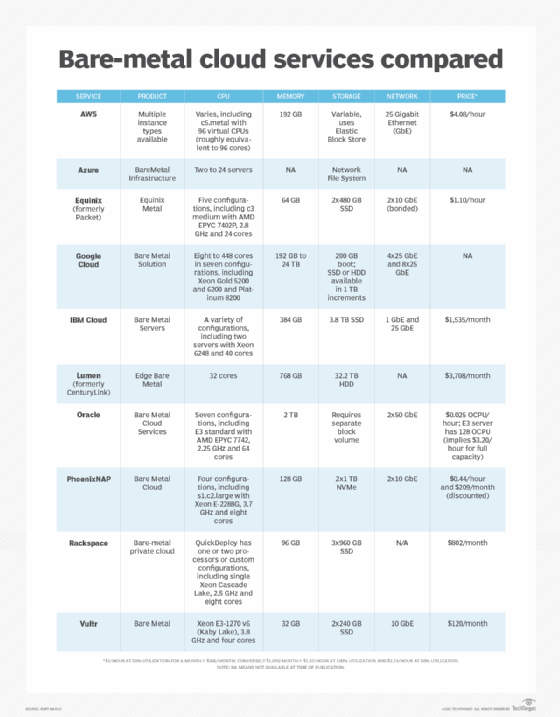
Bare-metallic cloud services include a range of performance and price options. Some vendors, such equally Google Cloud and Oracle, focus on high-stop configurations designed for databases and high-performance calculating applications. Smaller vendors similar PhoenixNAP and Vultr offer pocket-sized machines appropriate for developers and engineering workstations.
An organisation'south awarding requirements and reasons for choosing bare-metal cloud services over VM instances should be the primary considerations when evaluating bare-metal services. Other factors include:
- Existing relationships with cloud vendors. Organizations should consider the options bachelor from the cloud platforms they are already using for other workloads.
- Workload characteristics. Workloads should be examined to run into if they are variable or consistent and periodic or continuous. These backdrop volition make up one's mind the most economical billing model, whether it is on-demand or by-the-minute, hour or month.
- Availability and price. Check out these factors for supplementary storage, container, database, machine learning, security, identity and access management and DevOps services. Most organizations should not move a blank-metal workload to the cloud unless they intend to incorporate other infrastructure and application services or integrate blank-metal systems with other enterprise workloads that have been migrated to the cloud.
- It staff availability and expertise. Staff capabilities are required to run deject environments and ensure server and network security. Bare-metal cloud servers require users to gear up up and maintain arrangement configuration and security settings. Organizations that don't take the requisite experience to properly maintain a cloud server may face security and reliability risks when choosing blank-metal servers.
Blank-metal services are just ane of many services cloud service providers offer. Learn more about the top public cloud service providers .
This was concluding updated in June 2021
Continue Reading About bare-metallic cloud
- Discover the pros, cons of bare-metal cloud services
- Blank-metallic cloud services lure legacy workloads off premises
- Bare-metal container clusters: Infrastructure for side by side-gen apps
- Explore the benefits of containers on bare metal vs. on VMs
- Pedal to the blank metal: Equinix maxes out for scale-out
Dig Deeper on Cloud storage
-
![]()
Where to run containers? Bare metal vs virtual machines

Past: Antony Adshead
-

blank-metal hypervisor

Past: Brien Posey
-

cloud server

By: Wesley Chai
-

Virtual servers vs. concrete servers: What are the differences?

By: Rob Bastiaansen


What Are The Profit Margins Like For Bare Metal Cloud Service Resellers,
Source: https://www.techtarget.com/searchstorage/definition/bare-metal-cloud
Posted by: keyesreteneve.blogspot.com
0 Response to "What Are The Profit Margins Like For Bare Metal Cloud Service Resellers"
Post a Comment